 be a sequence of
independent random variables with common law
be a sequence of
independent random variables with common law
 ,
,
 where
where
 ,
,  and
and  being two fixed real numbers. Let
  and
and
The Cox-Ross random walk, widely used in Finance, is
defined as follows. Let
be a sequence of
independent random variables with common law
,
where
, and being two fixed real numbers. Let and
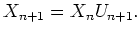
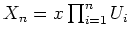 . It is easy to check that
 is an homogeneous Markov.
Let
 be a finite Markov chain following a Cox-Ross model,
we want to recursively compute for
be a finite Markov chain following a Cox-Ross model,
we want to recursively compute for
![$ n \in [0,T]$](img12.png) :
:
![$\displaystyle u_n(x)=\sup_{\tau \;{\cal F}_n t.a., n \leq \tau \leq N}
{\mathbb{E}} \left[ \frac{1}{(1+r)^{\tau+1-n}} f^\tau ( X^\tau) \vert X^n=x \right].
$](img13.png)
r=log(1 + 0.05);    // non risky interest rate
mu=0.05;   // unused
sigma=0.2; // volatility of risky asset
S0=40;    // price at time 0 of the risky asset
T=4.0/12.0;   // horizon
K=40;     //  strike value
N = 10;    // number of time steps
Dt = T/N;  // step size
R = r* Dt; // interest rate on time step
down = (1+R) * exp(- sigma * sqrt(Dt)); // state "up"
up = (1+R) * exp(+ sigma * sqrt(Dt)); // state "down"
p = (up-(1+R))/(up-down); // probability to go down !

a=up-1;
b=down-1;
X0=S0;
Question 1
For a given discrete time
 compute in a vector the possible states
of compute in a vector the possible states
of  . .
t=3; I=0:t; X=.... |
Question 2
Draw on a figure all the possible states that can be reached from
X0
when discrete time evolves from 0 to 
t=N; xbasc(); for i=0:t .... plot2d(...) // plot the states at time i with a mark end |
Question 3
The number of possible states at time
are
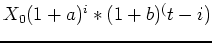 for for
![$ i\in [0,t]$](img18.png) .
Thus a given state at time can be labeled by its indice .
Thus a given state at time can be labeled by its indice  . Suppose that we are at time
in a state labeled what are the possible labels for the state at time . Suppose that we are at time
in a state labeled what are the possible labels for the state at time  . What are
the probabilities of the possible states. . What are
the probabilities of the possible states. |
Question 4
We want now to recursively compute the value function
V(x,n) and store all the
results in a matrix V. The number of rows of the matrix is given by the number
of possible states at the last discrete time  . At position . At position V(i,t) we will
store the value function at time t for the state labelled i.
Choosing
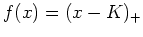 or or
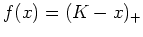 , give a function which recursively computes the value
function , give a function which recursively computes the value
function  .
During the computation we also want to compute .
During the computation we also want to compute U(x,n) which for a state labeled x at
time n return 1 or 2 (2 if the optimal strategy is to stop). |
Question 5
Compute also for each discrete time, the values of the state variables and
plot the value function according to the state value.
// The cost function at time T function y=f(x,K) .... endfunction // at each time we compute in a column of V the function value associated to states // X_0(1+a)^i*(1+b)^(t-i) T=10; I=0:T; XT=... n=.. // maximum number of states for t in [0,T] V=zeros(n,T); // initialize V X=zeros(n,T); // initialize X V(:,T)=... X(:,T)=... for t=T-1:-1:1 ... X(I+1,t)=... // I is the vector of possible indices at time t V(I+1,t) =... end // plot the value function at each step for t=1:T xbasc(); I=0:t; plot2d(X(I+1,t),V(I+1,t)) halt(); end |
Question 6
Use the
U matrix to plot the tree of discrete value for the state according to time
using a different mark for stopping or non-stopping states. |
Question 7
Use the previous code to implement a function which computes
the value function at time
for a given grid of state values.
Draw these functions for time evolving from 0 to . |