 |
(1) |
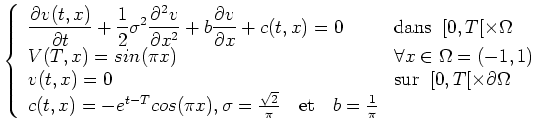
The following problem :
|
(1) |
 as an explicit solution. The aim of this tutorial
is to use finite difference approximations of the given PDE.
as an explicit solution. The aim of this tutorial
is to use finite difference approximations of the given PDE.
sigma = sqrt(2)/%pi; b = 1/%pi; L=1; T=1;
hmax= sigma^2/abs(b);  // state step must be lower than hmax
pmin=ceil((2*L)/hmax)+1;
p=maxi(pmin,20);       // number of discretization points
x = linspace(-L,L,p) ;  // discretization points
x = x(2:$-1)  ;       // remove boundary points.
h=x(2)-x(1);         // state discretization step.
Question 1
Using finite difference approximations approximate the
operator
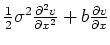 and
build a matrix and
build a matrix Ah such that the approximation is given by Ah*v. What are the properties
verified by Ah ? check numerically. |
sigma = sqrt(2)/%pi; b = 1/%pi; L=1; T=1;
hmax= sigma^2/abs(b);  // state step must be lower than hmax
pmin= ...
p=maxi(pmin,20);       // number of discretization points
x = linspace(-L,L,p) ;  // discretization points
x = x(2:$-1)  ;       // remove boundary points.
h=x(2)-x(1);         // state discretization step.

alpha = ..
beta =  ..
gama = ..
n= p -2 ;         // Approximate the diffusion operator
Ah= diag(beta*ones(1,n))+diag(gama*ones(1,n-1),1)+...
    diag(alpha*ones(1,n-1),-1) ;
Question 2
Using
Ah, use a  -schema to approximate the parabolic operator.
Two matrices are to be build -schema to approximate the parabolic operator.
Two matrices are to be build Bh and Ch in such a way the the discrete version
of the continuous operators reads as
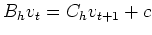 . Check the numerical properties
of . Check the numerical properties
of Bh and Ch. |
Question 3
Choose a time step which gives numerical stability, and solve numerically the
problem. Compare your solution with the explicit one. Compare the results with different
values of
. |
theta = ...
dtmax = ... // max time step
delta = dtmax/2;
q= ... ;
delta = ...
t = linspace(0,T,q+1); // discrete time

Bmh= ...
Ch= ...

 // final condition.
deff('[y]=f(x)','y=...')
fh = feval( x' , f);

// instantaneous cost.

deff('[y]=g(x,t)','...') ;
c=feval(x,t,g);         // la fonction \(c(t,x)\) }

v=zeros(n,q+1);
v(:,q+1)=fh ;    // initialisation de \(v(x,T) \)}
for i=(q:-1:1) ,
  v(:,i) = ...
end

plot3d(x/maxi(x),t,v/maxi(abs(v)),35,45,"X@T@V");

// compare with explicit solution.

deff('[y]=Vref(x,t)','y=exp(t-T)*sin(%pi*x)');
vref=feval(x,t,Vref);
Er=maxi(abs(vref-v))
Question 4
Note that you can use scilab to solve the linear system which gives
 but
you can also use an iterative method in the value iteration method spirit. but
you can also use an iterative method in the value iteration method spirit. |
We will here solve by finite differences the problem :
 |
(2) |
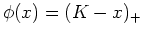 (put) or
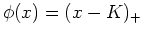 (call).
which is obtained when solving the black and scholes equation in the  version.
Question 5
Using finite difference approximations approximate the diffusion
operator by building a matrix
Ah such that the approximation is given by
Ah*v. What are the properties verified by Ah ? check numerically.
The discretisation will take care of the fact that we use null dirichlet boundary
conditions. |
r = 0.05; sigma = 0.3; // constants
hmax=...              // max value for state step size
h=..                  // selected step size
L=5; // x in [-L,L]   // we discretize x in [-L,L]
pmin= ..              // min number of points
p=maxi(p,100);
h = L/p;
x = ...              // discrete points

alpha = ...
beta =  ...
gama =  ...
n= 2*p+1;
Ah= diag(beta*ones(1,n))+diag(gama*ones(1,n-1),1)+ diag(alpha*ones(1,n-1),-1) ;
Question 6
Using
Ah, use a -schema to approximate the parabolic operator.
Two matrices are to be build S and R in such a way the the discrete version
of the continuous operators reads as
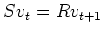 . Check the numerical properties
of . Check the numerical properties
of Bh and Ch. |
T=1;  // horizon
theta = 1/2; // theta used in the theta schema
dtmax = ... // statbility condition

delta = dtmax/2;
q= ceil((T/delta));
q=maxi(q,50);
delta = T/q;
t = T*(0:q)/q; // discrete times

S= ...
R= ...
Question 7
Solve the discrete parabolic problem
|
K= 40;

deff('[y]=f(x)','...')  // a call or a put
fh = feval( x' , f); // the value of v at time T
v=zeros(n,q+1);
v(:,q+1)=...  // final condition

// iteration

for i=(q:-1:1) ,
   v(:,i) =...
end

plot3d(x/maxi(x),t,v/maxi(abs(v)))
Question 8
Plot the solution when x is in the range
 . . |
xbasc();
i1=...
i2=...
xn=x(i1:i2)';
for i=1:q+1; plot2d(xn,v(i1:i2,i));end
Question 9
We can compare the numerical solution with an explicit one
(since
 and and  were constants). Compute the explicit solutions
for were constants). Compute the explicit solutions
for  then use the numerical solution and interpolation to obtain
a numerical value for then use the numerical solution and interpolation to obtain
a numerical value for  . You can use . You can use cdfnor to evaluate
the cumulative distribution function of the normal distribution and its inverse. |
S0=K;
d1=(1/(sigma*sqrt(T)))*(log(S0/K)+(r+sigma**2/2)*T);
d2=d1-sigma*sqrt(T);
call_price=S0*cdfnor("PQ",d1,0,1)-K*exp(-r*T)*cdfnor("PQ",d2,0,1);
put_price=-(S0-K*exp(-r*T))+(S0*cdfnor("PQ",d1,0,1)-K*exp(-r*T)*cdfnor("PQ",d2,0,1));

p = ...

// compare p with the call price or the put_price.
p -call_price  ...