
|
Halmstad 2006
Version pdf de ce document
|
Question 1
For a given discrete time
 compute in a vector the possible states
of compute in a vector the possible states
of  . .
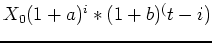
t=3; I=0:t; X=.... |
Question 2
Draw on a figure all the possible states that can be reached from
X0
when discrete time evolves from 0 to 
t=N; xbasc(); for i=0:t .... plot2d(...) // plot the states at time i with a mark end |
Question 3
The number of possible states at time
are
 for for
![$ i\in [0,t]$](img18.png) .
Thus a given state at time can be labeled by its indice .
Thus a given state at time can be labeled by its indice  . Suppose that we are at time
in a state labeled what are the possible labels for the state at time . Suppose that we are at time
in a state labeled what are the possible labels for the state at time  . What are
the probabilities of the possible states. . What are
the probabilities of the possible states. |
Question 4
We want now to recursively compute the value function
V(x,n) and store all the
results in a matrix V. The number of rows of the matrix is given by the number
of possible states at the last discrete time  . At position . At position V(i,t) we will
store the value function at time t for the state labelled i.
Choosing
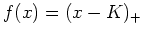 , give a function which recursively computes the value
function. , give a function which recursively computes the value
function. |
Question 5
Compute also for each discrete time, the values of the state variables and
plot the value function according to the state value.
// The cost function at time T function y=f(x,K) .... endfunction // at each time we compute in a column of V the function value associated to states // X_0(1+a)^i*(1+b)^(t-i) T=10; I=0:T; XT=... n=.. // maximum number of states for t in [0,T] V=zeros(n,T); // initialize V X=zeros(n,T); // initialize X V(:,T)=... X(:,T)=... for t=T-1:-1:1 ... X(I+1,t)=... // I is the vector of possible indices at time t V(I+1,t) =... end // plot the value function at each step for t=1:T xbasc(); I=0:t; plot2d(X(I+1,t),V(I+1,t)) halt(); end |
Question 6
Use the previous code to implement a function which computes
the value function at time
for a given grid of state values.
Draw these functions for time evolving from 0 to .
// fix a time and compute the V value on a grid function v=compute_V(T,X0) ... v=V(1,1); endfunction X=linspace(K-10,K+10,100); V=zeros(X); for T=0:10 // Compute V(i) value at 0 for initial state X(i). ... plot2d(X,V,style=T) halt(); end |
We want now to verify that given the price  at time 0 of a call,
we can manage a portfolio with initial value which contains the non risky asset
and the risky asset in order to bring the portfolio value to
at time 0 of a call,
we can manage a portfolio with initial value which contains the non risky asset
and the risky asset in order to bring the portfolio value to f(X_T,K) at time .
Using the previously programmed function compute_V(N,S0) we can write
// price at time 0 of the call with horizon N
function[Y]= price(n,N,S0)
  Y= compute_V(N-n,S0);
endfunction

// the quantity of risky asset that we must have at time $n$
function[Y]= hedging(n,N,x)
  Y = (price(n+1,N,x*up)-price(n+1,N,x*down)) / (x*(up-down))
endfunction
Now using the policy given by hedging and a possible sample of
 in a vector
 cours we can compute the evolution of the
portfolio :
function [res]=check_hedging(N,cours)
  S = cours(1)
  V = price(0,N,S);
  H = hedging(0,N,S);
  SoHo = V - H * S;
  for n=1:N-1
     S      = cours(n+1);
     V      = H * S + SoHo * (1+R);
     H      = hedging(n,N,S);
     SoHo   = V - H * S;
  end;
  V = H * cours(N+1) + SoHo * (1+R);
  res = V - f(cours(N+1),K);
endfunction
Question 7
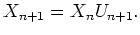
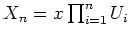
Use random generator to generate samples of a Cox-Ross
model for
and a given probability. Then use check_hedging to check
that the portfolio value at  is equalt to the value function is equalt to the value function f.
You can modify the previous function to get also a trajectory for the portfolio
value and make drawings of its time evolution. Note that the result does not
depend |







![$ n \in [0,T]$](img12.png)
![$\displaystyle v_n(x) = {\mathbb{E}} \left[ \frac{1}{(1+r)^{T+1-n}}f(T,X_{T}) \vert X_{n} = x \right],
$](img13.png)