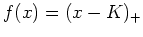
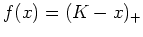
The Cox-Ross random walk, widely used in Finance, is
defined as follows. Let
 be a sequence of
independent random variables with common law
be a sequence of
independent random variables with common law
 ,
,
 where
where
 ,
,  and
and  being two fixed real numbers. Let
  and
and
Question 1
For a given discrete time  compute in a vector the possible states
of compute in a vector the possible states
of  . .
  t=3;
  I=0:t;
  X=....
|
Question 2
Draw on a figure all the possible states that can be reached from X0
when discrete time evolves from 0 to 
t=N;
xbasc();
for i=0:t
  ....
  plot2d(...) // plot the states at time i with a mark
end
|
Question 5
Compute also for each discrete time, the values of the state variables and
plot the value function according to the state value.
// The cost function at time T
function y=f(x,K) .... endfunction

// at each time we compute in a column of V the function value associated to states
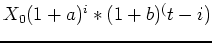
// X_0(1+a)^i*(1+b)^(t-i)

T=10;
I=0:T;
XT=...
n=.. // maximum number of states for t in [0,T]
V=zeros(n,T); // initialize V
X=zeros(n,T); // initialize X


V(:,T)=...
X(:,T)=...

for t=T-1:-1:1
  ...
  X(I+1,t)=... // I is the vector of possible indices at time t
  V(I+1,t) =...
end

// plot the value function at each step

for t=1:T
  xbasc();
  I=0:t;
  plot2d(X(I+1,t),V(I+1,t))
  halt();
end
|
Question 6
Use the U matrix to plot the tree of discrete value for the state according to time
using a different mark for stopping or non-stopping states.
|
Question 7
Use the previous code to implement a function which computes
the value function at time for a given grid of state values.
Draw these functions for time evolving from 0 to .
|

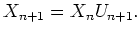
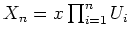 . It is easy to check that
 is an homogeneous Markov.
![$\displaystyle u_n(x)=\sup_{\tau \;{\cal F}_n t.a., n \leq \tau \leq N}
{\mathbb{E}} \left[ \frac{1}{(1+r)^{\tau+1-n}} f^\tau ( X^\tau) \vert X^n=x \right].
$](img13.png)

![$ n \in [0,T]$](img12.png)
![$ i\in [0,t]$](img18.png)