We want to buy a house deciding which one to buy by visiting a fixed sequence of  houses.
The houses have a value
houses.
The houses have a value  (
(
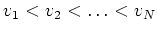 ) which are not know in advance.
We obtain the value of a current house at the time we visit it and we are then able to compare
its value with the previously visited ones. We assume that the probabilistic model is that
when visiting a sequence of house we will visit a random permutation of the houses with
a uniform law on all the random permutations.
When we visit the
) which are not know in advance.
We obtain the value of a current house at the time we visit it and we are then able to compare
its value with the previously visited ones. We assume that the probabilistic model is that
when visiting a sequence of house we will visit a random permutation of the houses with
a uniform law on all the random permutations.
When we visit the  -th house we can decide to stop and buy the house or to continue it is
not possible to come back on a non-selected house.
Let
-th house we can decide to stop and buy the house or to continue it is
not possible to come back on a non-selected house.
Let  defined as follows :
Our problem is a stoping time problem. We have to decide at which time to stop in
order to maximize the probability that we have chosen the best house.
We want to compute  and obtain the associated optimal strategy (note that
 ),
where
),
where  is given by :
Question 2
We assume here that the values  . Use . Use grand to obtain a random
permutation of
![$ (v_i)_{i \in [1,N]}$](img26.png) . .
|
Question 3
Compute along the trajectory the value of  and compute the stoping time. and compute the stoping time.
|
Question 4
Use monte Carlo simulation to evaluate the optimal value function.
|

![$\displaystyle S_k = \left\{ \begin{array}{l} 1 \quad\mbox{si}\quad
W_k =k \qua...
...}_{j\in [1,k]} v_{\sigma(j)} \\
0 \quad\mbox{sinon}\quad
\end{array} \right.
$](img6.png)
 is a Markov chain with
  as state space and transition matrices
 are as follows :
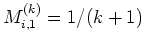 and
and
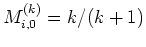 (Note that the
  are in fact independent).
![$\displaystyle u_n(x) \equiv \sup_{\tau \;{\cal F}_n t.a., n \leq \tau \leq N}
{\mathbb{E}} \left[ g_\tau ( S^\tau) \vert S_n =x \right].
$](img16.png)
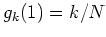 and
and
 .
.

![$ n\in[1,N]$](img20.png)


